 Bowtie One
Critical risk management
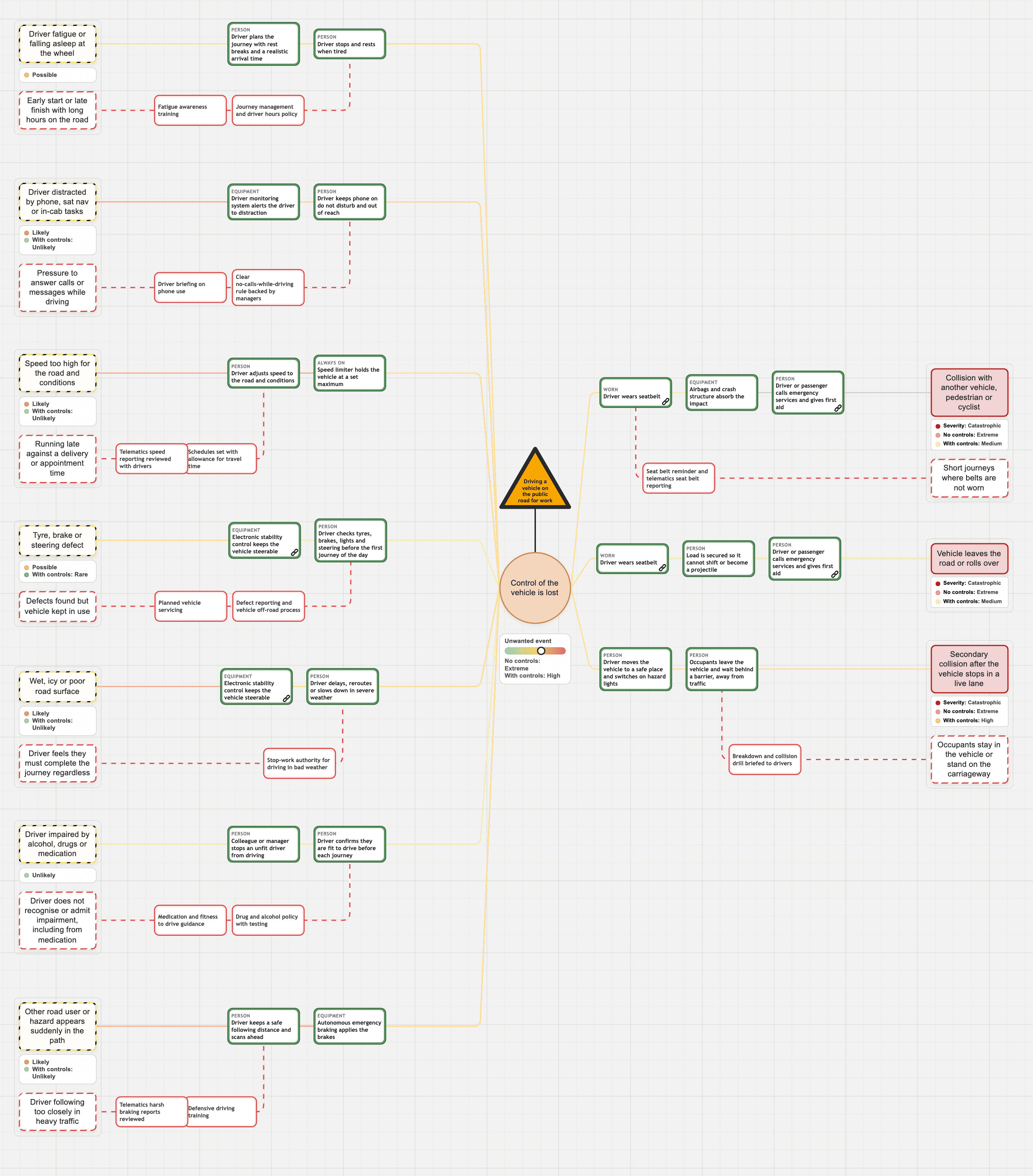
See what is actually protecting your people.
Every business has a handful of activities that could seriously injure or kill someone. Working at height. Confined spaces. Excavations. Hot work. Bowtie One turns each one into a single picture — what could go wrong, what you are relying on to stop it, and where that protection is thinner than you think.
No account needed. Building is free.
New · Works with your AI assistant
Build a bowtie in seconds. Then let it find your gaps.
Connect Bowtie One to Claude, ChatGPT or Grok and ask for what you need in plain English. Your assistant builds the bowtie straight into your account, scores it with Bowtie One's own method, and tells you where your critical controls are thinner than you thought.
 Claude
 ChatGPT
 Grok
Grok
“Build a bowtie for digging near buried services, based on HSG47.”
“Build a bowtie for trenching and excavation, following OSHA's excavation standard.”
“Here's our forklift risk assessment. Turn it into a bowtie.”
“Which pathways on my driving bowtie are worst, and what would bring them down?”
From a prompt to a full bowtie
Name the activity, or the guidance you work to — HSG47, an OSHA standard, your own procedure — and get the causes, barriers, escalation factors and outcomes laid out in seconds, ready to open in the builder.
Start from what you already have
Upload a risk assessment, a method statement or a procedure to your assistant and have it turned into a bowtie. The controls buried in the paperwork end up on one page, exactly where they act.
See your critical risks first
Every cause-to-outcome pathway is scored with the same method as the builder and listed worst first, so the handful that could kill someone are at the top — not lost in a register.
Find the gaps in your controls
Lines with no real barrier, paperwork standing in for a physical control, PPE on the wrong side, a single barrier carrying a fatal outcome — the review names each gap and the action it needs.
Improve it in conversation
Ask what would bring a pathway down, add a barrier, rename one so it says who does what, or add what defeats it. The method is built in, so training and inspections stay where they belong.
You stay in control
Every change is saved in the board's version history first. Choose read-only or read-and-edit when you connect, disconnect at any time. The assistant can never delete a bowtie or share it with anyone.
Uses your own Claude, ChatGPT or Grok account. Needs a Bowtie One membership.
The method
One picture, six parts
A bowtie reads left to right, like the job itself. It takes about an hour to map an activity, and the result is something a supervisor, a director and a new starter can all read without training. Here is the whole of it.
The activity
The job with the potential to hurt someone — working in an excavation, entering a tank, lifting over a live area. In bowtie language this is the hazard. It sits at the top of the picture.
What could go wrong
The realistic ways the job turns bad, each on its own line into the middle. Sides left unsupported. Spoil stacked at the edge. Plant working too close. These are called threats.
What stops it
Everything you are relying on to keep each of those from happening — the trench box, the permit, the exclusion zone, the pre-start check. These are your controls, and this is usually the first time people see them all written down in one place.
The moment it goes wrong
The point where you have lost control of the job. The excavation collapses. Not the injury yet — the event itself. It sits in the knot of the bowtie, and everything on the picture is arranged around it.
What limits the harm
The controls that only matter once it has already happened. The standby person. The rescue plan. Detection and alarms. They cannot prevent the event, but they decide how badly it ends.
What happens to people
The realistic outcomes if those last controls fail too — a worker buried, someone crushed by plant. Each one carries its own severity, so the picture ends with the thing that actually matters.
Capabilities
What you get
Building is free. The paid plan is about getting the work out of the browser, keeping it somewhere, and sharing it with the people who need it.
Map an activity in an afternoon
Add what could go wrong, the controls standing in the way, and the outcomes — straight onto the canvas. Undo, redo, and a neaten-up command that lays the board out for you.
See every control in one place
Record what each control is, what kind it is, and how strong it really is. Colour the board by strength and the thin spots stop hiding inside a procedure nobody has read.
Find what defeats your controls
A control can exist on paper and still not be there when it matters — ground conditions change, an inspection is deferred. Map those, and what you do about them.
Know how bad it could get
Every outcome carries a severity, an initial risk and a residual risk, recalculated as your controls change. Colour by either one to see where you still carry exposure.
Show the difference controls make
Give each cause a likelihood and the board totals it up for the event itself — so you can show, on one screen, what your controls are actually buying you.
Keep them and review them
Save boards to your account, organise them on a dashboard, set review dates so they do not quietly go stale, and invite colleagues to view or edit. Paid plan.
Pricing
What it costs
You can map a complete activity without paying anything, or even making an account. Paying is about getting it out of the browser and working on it with other people.
Free
£0
Map as much as you like.
- Unlimited boards
- Causes, controls, outcomes and what defeats them
- Control strength and type
- Severity, initial risk and residual risk
- Automatic autosave in your browser
Pro
£12/month
or £120/year — 2 months free
Keep it, share it, review it.
Everything in Free, plus:
- Save boards to the cloud
- Import and export project files
- Export as a PDF report
- Dashboard with review dates
- Invite colleagues to view or edit
- Start from saved templates
- Connect Claude, ChatGPT or Grok
Questions
Common questions
What is a bowtie, in plain English?
It is one picture of one dangerous activity. The causes run in from the left, the moment you lose control sits in the middle, and the outcomes fan out to the right. Everything you rely on to stop it is drawn in between, exactly where it sits. The shape is where the name comes from. It is used heavily in oil and gas, mining, rail and construction because it makes a risk legible to people who are not risk specialists.
Do I need a safety specialist to use this?
No. If you know how the job is done, you know most of what goes on the board — the ways it can go wrong and the things you rely on to stop it. That is the point: the people who understand the activity are the ones who should be mapping it. A specialist is useful for reviewing it, not for producing it.
Which activities should we start with?
The ones that could kill someone rather than the ones that happen most often. Working at height, confined space entry, excavations, hot work, lifting operations, energy isolation, vehicle and pedestrian interaction. Most organisations find they have somewhere between eight and fifteen. Start with one and you will know within an hour whether the picture tells you something you did not already know.
How is this different from the risk assessment we already have?
A risk assessment usually tells you the risk is controlled. A bowtie shows you exactly what is doing the controlling, and lets you ask whether you would bet someone's life on it. They work together — the bowtie is the picture underneath the paperwork, and it is what people actually remember when they are standing at the edge of the hole.
Can I use it with ChatGPT, Claude or Grok?
Yes. With a membership you can connect your own AI assistant and ask it to build, review and improve your bowties — from a prompt, from guidance like HSG47 or an OSHA standard, or from a risk assessment you upload. It works through your own AI account, every change it makes is kept in the board's version history, and it can never delete a bowtie or share it. The AI assistants page has the setup for each one.
Do I need an account to try it?
No. Open it and start — nothing is gated behind a signup, and your work saves automatically in your browser. You only need an account when you want to save to the cloud, export a file, or share a board with someone.
What happens to our data?
If you are not signed in, everything stays in your own browser and never reaches a server. If you save to the cloud, boards are stored against your account and are only visible to you and the people you explicitly invite.
Contact
Get in touch
Questions about whether this fits how you work, something you need it to do, or a problem you have run into — send it here and it comes straight to me. I read everything.